

Code of Conduct
PHS Code of Conduct: Rules & Regulations
Discipline is an educative process, and the goal is to instil self-discipline and good character in students. The school believes that the foundation for every PresHighian is exemplary character, and that every student is able to practise self-discipline.
The school rules aim to enable students to Lead Self by nurturing responsibility and self-discipline, and Lead Others by fostering a safe and conducive environment for the community. The school expects every student to maintain high standards of his/her personal conduct, academic work and CCA participation.
GENERAL CONDUCT
a) Be polite, well-behaved and considerate to others at all times, upholding the name of the school.
b) Show respect and obey school authorities, e.g. Principal, Vice-Principal, teachers and non-teaching staff.
c) Greet all teachers and visitors when you meet them.
d) Take care of all forms of school property within the school premises.
e) Report any form of misconduct, in and outside of school, that is contrary to school values to school authorities.
f) Play an active role in keeping the school safe by informing school authorities if you see:
○ any undesirable outsider loitering within the school or just outside the school perimeter
○ offences committed by our student(s) in or outside the school compound.
g) To be a good ambassador outside of school premises, students should always be properly attired. Students should conduct themselves well and uphold a positive image of the school at public places, e.g. when using public transport and during visits to external organisations.
ATTENDANCE
a) Students must be punctual and present for all school lessons, CCA and other school-related activities.
b) Students must attend morning assembly every day. Their attendance will be taken by their Form Teachers. Subject teachers will check the class attendance at the start of every lesson. The Class Chairperson must inform the subject teachers and Form Teacher if any student is found to be missing from the class.
c) Any student who is unable to attend school is expected to inform the school on the day of absence. All absences must be accounted for with valid reasons, e.g. Medical Certificate (MC) upon his/her return to school. Medical Certificates from Traditional Chinese Medicine (TCM) practitioners are not accepted. Where there is irregular attendance or absence without valid reasons, the student’s parents will be invited to the school to meet with the Form Teachers.
PUNCTUALITY
a) Latecomers must report to the Security Guard Room or Discipline Aide/ Discipline Coordinator.
b) Students who are late will have to serve consequences that include detention or suspension.
WILFUL ABSENTEEISM
a) If any student persistently demonstrates an unwillingness to benefit from the opportunity to receive education by playing truant, he/she is liable to be expelled on grounds of wilful absenteeism.
b) The consequences of wilful absenteeism include being barred from either school or national examinations.
LEAVING THE SCHOOL COMPOUND
a) A student who feels unwell while in school must inform his/her teacher. The student may obtain permission to leave the school early. Forms for this purpose should be filled in duplicate and submitted to the Form Teacher.
b) Parents/Guardians are encouraged to accompany the unwell student home. A student would be discouraged from going home if there is no one to supervise him/her at home. Under such circumstances, he/she is allowed to rest in the sick bay.
c) Students who leave the school without permission will face disciplinary action.
BEHAVIOUR DURING FLAG RAISING CEREMONY
a) The flag raising ceremony starts at 7.30am every day. All students are encouraged to arrive in school earlier and be assembled at the assembly square (or Hall on rainy days) by 7.25am.
b) Students who are Singapore Citizens must sing the National Anthem and take the Pledge. Students should take the Pledge with the right fist placed over the heart.
c) Be respectful and attentive when devotion is being delivered.
d) Pay attention when announcements are made.
e) Have the appropriate reading materials for silent reading.
BEHAVIOUR DURING RECESS
a) Do not remain in class during recess, unless authorised by the teacher.
b) Students should make their way to the canteen in an orderly manner.
c) Queue up to make purchases.
d) Consume all food and drinks in the canteen only. No sweet drinks or food should be brought to the classroom.
e) Return all utensils to the receptacles provided. All food waste and empty food and drinks containers/wrappers should be thrown into the bins provided.
f) Students are reminded to keep the noise level in the canteen low, especially when the Hall is in use.
g) Return to class promptly at the end of recess.
GUIDELINES FOR UNSTRUCTURED PLAY
a) Students are allowed to engage in unstructured play during school hours when they have no lessons in the following venues: Basketball at the Basketball Court (ISH1) and Soccer at the School Field.
b) Outdoor play is not allowed between 11am and 3pm.
c) Students should play responsibly and safely, be aware of others and no rough play.
d) Students must report all incidents or injuries sustained at the General Office and seek help promptly.
CLASSROOMS CONDUCT
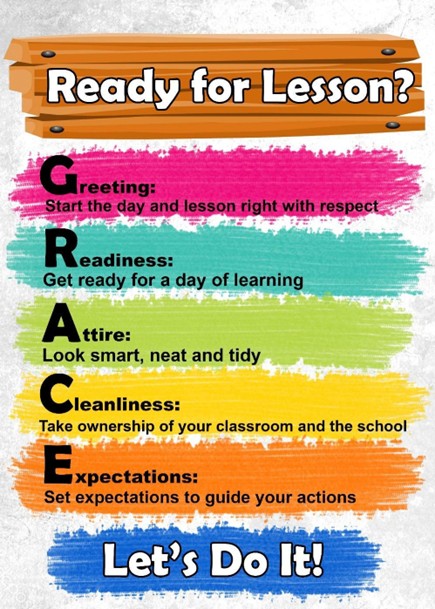
a) Observe the GRACE routine.
b) Students should seek permission and obtain an exit pass from the teacher before leaving the class.
c) Classrooms should be kept clean at all times. The cleanliness of the classrooms is the responsibility of the students.
d) Show consideration to others by keeping the noise level low.
e) Switch off all lights, fans and projector in the room after use.
SCHOOL UNIFORM
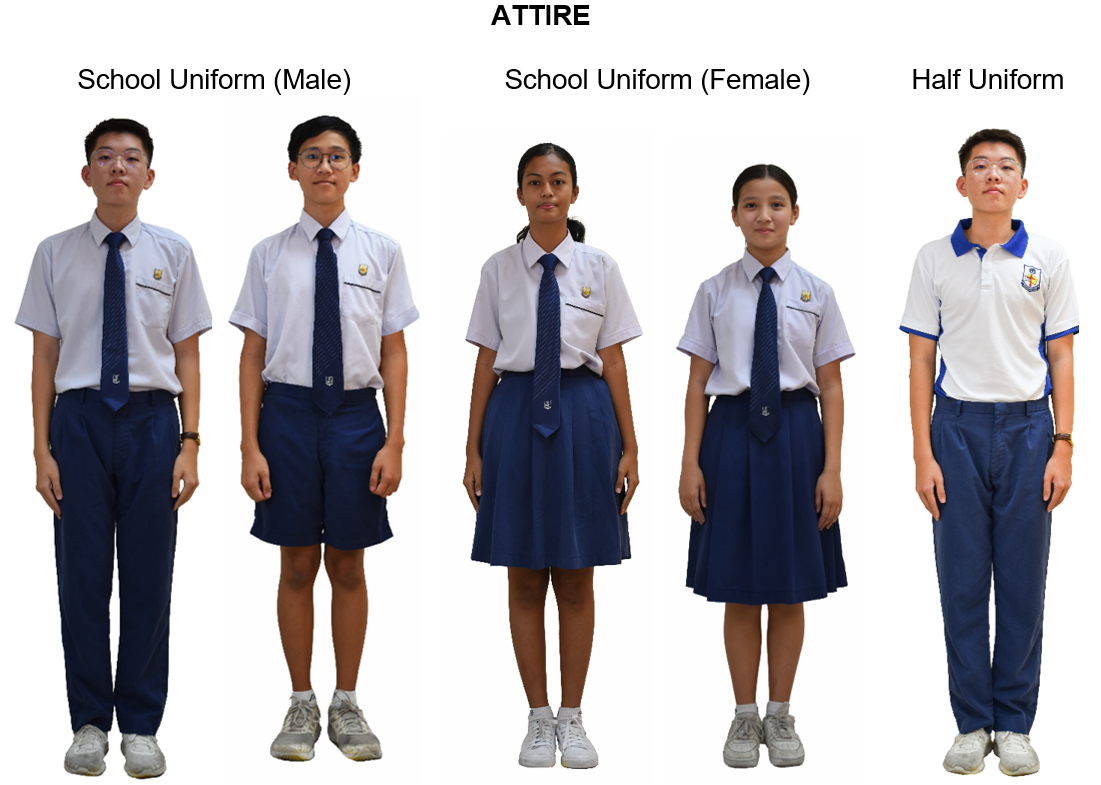
a) Students are to wear the prescribed school uniform. Any form of modification to the uniform is NOT allowed.
b) Every Wednesday, students are to wear the formal school uniform, i.e. shirt/blouse and pants/shorts/skirt.
c) Students are allowed to wear half uniform on other days of the week. Half uniform comprises the Polo T-shirt and school pants/shorts/skirt.
d) Students’ pride in the school is shown by the way they wear their school uniform. Shirts/blouses should be tucked in. Female students’ skirt should not be shorter than 3 cm above the knee. Male students should not be wearing pants that are too tight or too short.
e) Students should not fold the sleeves of their shirts/blouses.
f) Students who come to school during the holidays must be in full or half school uniform, with socks and covered shoes.
g) PE Attire: School PE T-shirts can only be worn during PE lessons, CCA and other specified school activities. Students should change into their school uniform after recess.
h) Shoes and Socks: Standard white shoes and white Presbyterian High School socks are part of the school uniform. Coloured track shoes are not to be worn except for CCA. Wearing slippers to school is prohibited.
i) School Badge: Students must always wear the school badge (pinned above the shirt pocket) while in school uniform.
j) School Tie: The school tie must be worn with pride during chapel service and at special functions specified by the school.
k) Warm Clothing: Students may wear approved school jackets or plain coloured jackets (black/blue/white/grey) without wordings or design when the weather is chilly.
l) Headgear: Any type of headgear is not allowed in school. This includes headbands, hoods and hats/caps.
m) Indiscreet and indecent undergarments or coloured bras that call attention to themselves are not allowed in school at all times.
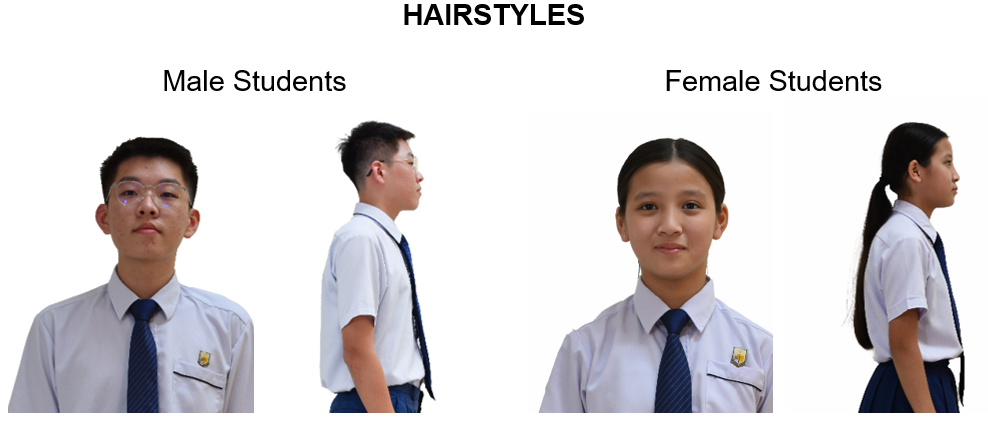
HAIRSTYLES
MALE STUDENTS
a) Hair must be short and neat; with a slope at the back and not touching the collar.
b) Hair must not touch the ears and the fringes are not to touch the eyebrows.
c) Hair must not be coloured, dyed or styled with any other hair products.
d) No extreme, elaborate, permed or attention-seeking hairstyle is allowed.
e) Facial hair is not allowed. Students must be clean-shaven and neat in appearance.
FEMALE STUDENTS
a) Female students with long hair must have their hair plaited or tied up. Ribbons, hair clips and hair bands should be plain black or dark blue.
b) Hair must not be coloured or dyed.
c) Hair that is longer than the upper end of the collar must be tied up neatly.
d) Fringes are not to touch the eyebrows.
e) No extreme, elaborate, permed or attention-seeking hairstyle is allowed. No hair extension is allowed.
HAIRSTYLES
ATTIRE
ORNAMENTS AND JEWELLERY
a) Only female students are allowed to wear one pair of similar, small, round ear studs. The diameter of the studs should not be more than 3mm. Only one ear stud may be worn on each ear lobe.
b) No jewellery or ornaments are to be worn in school.
c) While no talisman or religious item is to be worn, these items may be kept in the purse or wallet.
d) No tattoo is allowed on any part of the body. Removal of tattoo is to be done.
FINGERNAILS AND MAKE-UP
a) Fingernails must be kept short and neat.
b) No nail polish is allowed.
c) Students are not allowed to use any form of make-up.
SPECTACLES
Bespectacled students must not use tinted lenses. Spectacles with fanciful frames are not allowed.
SCHOOL BAGS
Fanciful or branded school bags are not allowed in school.
PERSONAL BELONGINGS
a) Students are responsible for their personal belongings.
b) Students’ mobile devices, wallets and money should be secured at all times. These valuables are to be kept in the classroom locker and secured with a lock.
c) Expensive personal items should not be brought to school. The school shall not be responsible for the loss of these items.
MOBILE AND ELECTRONIC DEVICES
a) Students are allowed to bring mobile devices to school. However, there are restrictions on their use in school so that they do not become distractions to learning during school hours.
b) Usage of mobile devices is allowed before the 7.25am bell and after school dismissal time (Timing is subjected to individual class timetable).
c) Usage of mobile devices is limited to the school canteen area and outside the General Office.
d) Mobile devices are to be switched off and kept in the classroom lockers (to be secured with a lock) during school hours. This will help to prevent theft and distractions during the time in school.
PERSONAL LEARNING DEVICES (PLD)
a) PLDs are learning devices and not entertainment devices. Students are to use their PLDs in a responsible manner.
b) During lessons, the PLDs are to be placed on the table at all times:
○ When in use, students are to place it on the table.
○ When not in use, students are to place it upright with the screen facing the teacher.
○ When not in use for the entire lesson, students are to place it on the table with the cover closed or put away in their bags.
c) Students are not to record videos or take photographs, unless with the teacher’s permission.
d) SDL periods are official curriculum time so students are expected to be doing their self-study. Students are not allowed to use their PLD during SDL periods for entertainment e.g. watch Youtube videos and play online games. If students have finished their work, they are to read their story books.
PROHIBITED ITEMS
a) All students are not allowed to have in their possession any weapon. They are also not allowed to bring any weapon-like item which is used or intended to be used to cause harm to others.
b) The following items are strictly banned in school:
○ playing cards or gambling cards
○ chewing gum
○ correction fluid
○ any item that is illegal or poses a risk to the health and safety of others.
COMMITTING OF OFFENCES
a) Minor offences will be managed by Form Teachers or Subject Teachers.
b) Students who commit major offences or repeatedly commit minor offences will be referred to the respective Discipline Coordinator or the Discipline Master.
c) Consequences will be meted out according to the school rules.
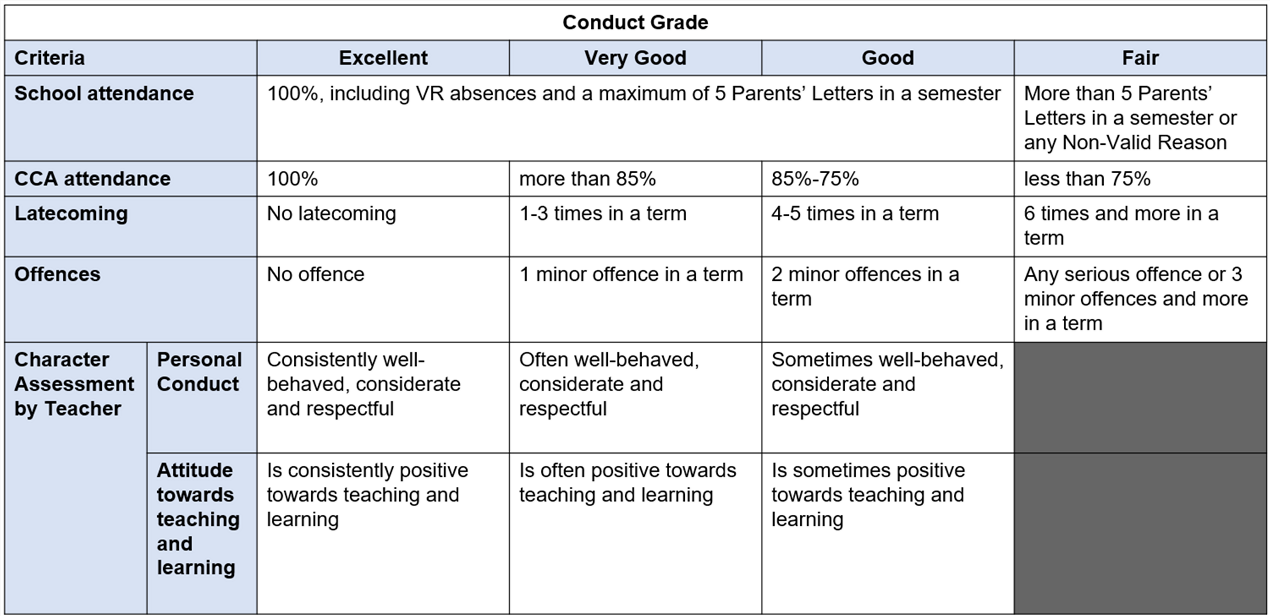
Students should note that a ‘Fair’ conduct grade will negatively affect
their eligibility for:
Edusave Awards and school-based awards
School representation in competition and games the selection for school
programmes and activities.